
Hot Water
Hot Water System Installation Cost: What Drives the Price
Two hot water jobs in the same street can be priced very differently. Here’s what actually moves the number, and how to work out which kind of job you have.
· 7 min read
On acreage, the whole water cycle is yours — supply, pressure and wastewater. We’re based in Castle Hill with the Dural, Kenthurst, Glenorie and Annangrove acreage twenty minutes up the road, so this is everyday work for us rather than something we occasionally get asked about.
No call-out fee. We’ll call you straight back.
Sound familiar?
If any of these describe what’s happening at your place, we can help — usually the same day.
The absorption area has stopped absorbing. It’s the classic septic failure and it gets worse every week it’s used.
On an unsewered property that usually means the tank is full or the outlet is blocked — not a blockage inside the house.
Usually the pump, the blower or a float switch. Don’t just silence it — the alarm exists because untreated effluent is about to go somewhere.
Pressure pump or pressure vessel. A waterlogged vessel makes the pump cycle constantly and kills it early.
Could be the pump, the switch, or a leak somewhere on the line making it think you’ve opened a tap.
A leak on a buried run, a passing toilet, or a trough float that has stopped closing. All findable.
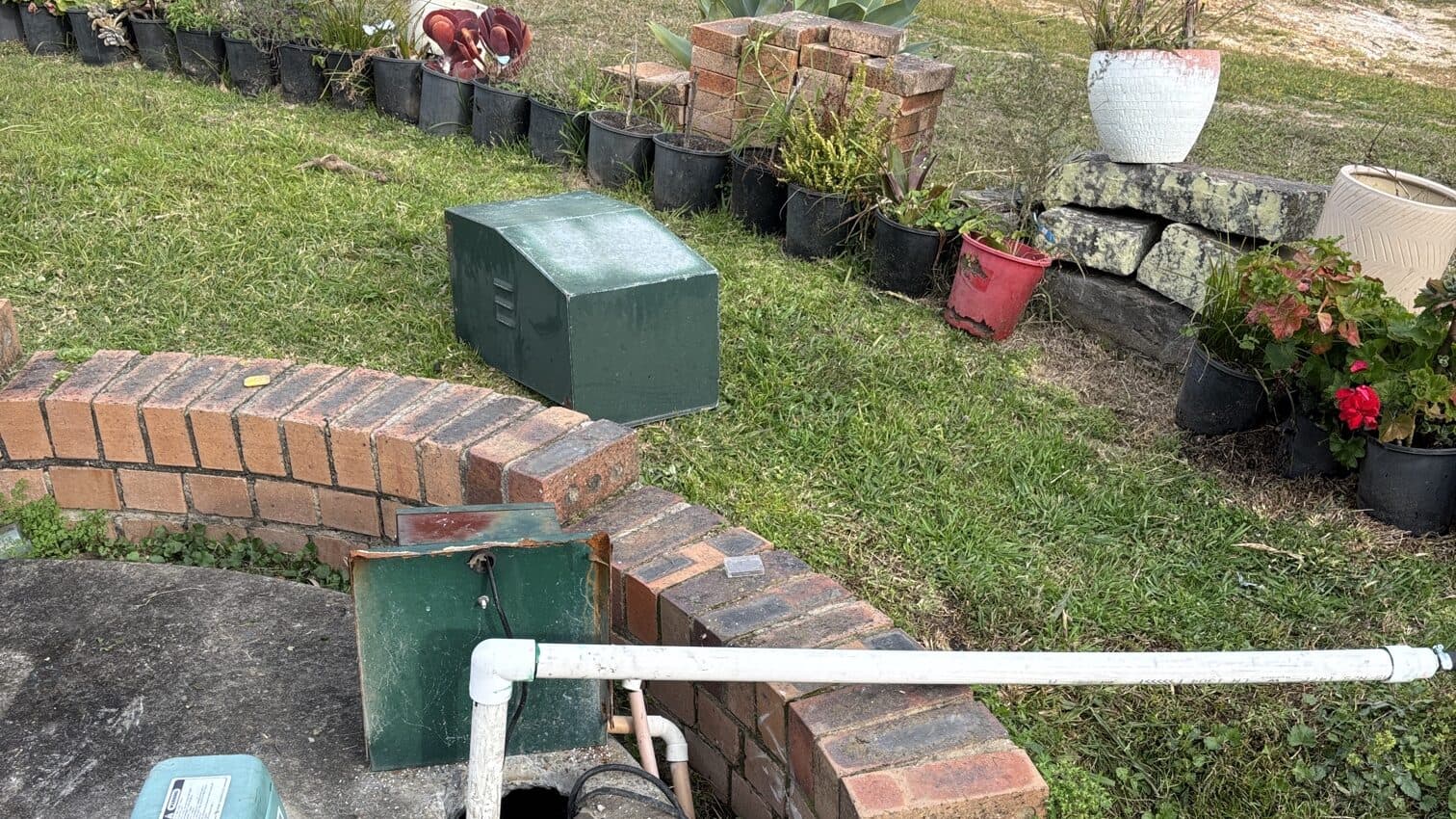
A house on mains water and mains sewer has two problems it can have. A house on tank water and a septic system has five, and four of them are outside. That’s why an acreage call-out that starts "the pressure is bad in the shower" gets diagnosed at the pump shed rather than in the bathroom.
We check the draw from the tank, the pump, the pressure vessel and the filtration before we go anywhere near a fixture. Most of the time the fault is in that chain, and replacing a shower mixer would have achieved nothing.
Two broad types out here. Traditional septic tanks discharging to absorption trenches, and aerated wastewater treatment systems that treat the effluent and irrigate it. They fail differently: septic trenches fail gradually as the soil clogs, treatment systems fail suddenly when a pump, blower or float goes.
We repair the plumbing side of both — inlet and outlet lines, blockages, failed pumps and float switches, distribution boxes and the pipework to the irrigation field. Scheduled servicing and effluent quality reporting on an aerated system is a separate accreditation, so if yours needs its quarterly service we’ll tell you that straight rather than pretending otherwise.
One thing worth knowing before you renovate: adding a bathroom or a granny flat adds load to a system that was sized and approved for the original house, and council approval for the wastewater system is a separate question from your building approval. Ask before you build, not after.
Acreage means distance. A supply line can run a hundred metres from the meter or the tank to the house, then more again to a shed, a stable or a second dwelling. Those runs were often laid decades ago by whoever owned the place then, in whatever material was to hand, and are on no drawing anywhere.
So a leak doesn’t announce itself with a damp patch on a wall — it soaks into a paddock and shows up as a pump that runs at 3am or a tank that empties too fast. Finding it is a job for isolation and acoustic detection, and it saves an enormous amount of pointless trenching. It’s the most common leak detection work we do outside the sewered suburbs.
Most properties out here keep a static water supply for firefighting, and a good proportion of those have never been tested. A tank with a seized valve, a pump that won’t prime or a fitting the brigade can’t couple to is not a water supply.
It takes very little to check, and spring is the time to do it rather than during a fire ban. We’ll test the draw, the pump and the fittings while we’re on site for something else if you ask.
How it works
Tank or mains, septic or treatment system, pump or gravity — it changes everything.
Tank, pump, vessel, filtration and lines, in that order.
Including whether a pump is worth repairing or has reached the end.
You’ll know what failed, why, and what will make it last longer.
Customer reviews
“I would like to thank Rohan & the team for coming to my home in Castle Hill. They did a fantastic job replacing my old hot water system, and they gave me a great deal on other plumbing options. The best thing was, they were neat and tidy compared to most other tradies I would highly recommend Precision Pipes”
“We recently used Ben from Precision Pipes and couldn’t be happier with the service. Ben was punctual, transparent, and kept us informed every step of the way. He went above and beyond to explain what was happening and made the whole process stress-free. If you’re looking for an honest, reliable plumber in the Hills District, I wouldn’t hesitate to recommend Ben and the team at Precision Pipes.”
“I’ve been using Precision Plumbing for the past year for both reactive and preventative plumbing maintenance. Rohan and his team have consistently been reliable, punctual, and professional, delivering high-quality workmanship on every job. I highly recommend Precision Plumbing to anyone looking for a trustworthy and dependable plumbing service.”
Where we work
Based in Castle Hill and covering the whole of the north-west and upper north shore.
Common questions
It depends entirely on what has failed. A blocked outlet or a failed float switch is a small job. A pump replacement is a moderate one. A saturated absorption trench that has reached the end of its usable life is a much larger project, often needing council involvement and a new disposal area. We’ll tell you which of the three you’re looking at after we’ve inspected it, with a fixed price and no call-out fee — and we’d rather tell you the trench is failing early than sell you three repairs first.
Nine times out of ten it’s the pressure system rather than the plumbing. The usual causes are a waterlogged pressure vessel making the pump short-cycle, a pump that’s undersized for the distance and height it’s pumping, a blocked inlet filter, or the tank level being low enough that the draw is starving. All of those are fixable, and none of them are fixed by changing a shower head.
We repair the plumbing and pump side — failed pumps, blowers, float switches, blocked lines and irrigation pipework. The scheduled quarterly service and effluent reporting that your council requires needs a specific accreditation for your system’s make, so that part usually goes to an accredited servicing agent. We’ll say so upfront rather than take the job and sub it out.
Often yes, but not automatically. Your wastewater system was sized and approved for a certain number of bedrooms and a certain daily load, and adding to it needs the system reassessed and usually a separate council approval. Doing the building work first and asking afterwards is how people end up with an approved granny flat they can’t legally connect. Ask at design stage — it’s a short conversation.
Typically every three to five years for a household, though it depends on the tank size and how many people are using it. Signs you’ve left it too long are slow drains everywhere at once, gurgling, and solids carrying over into the trenches — which is what destroys an absorption area. Pumping out is done by a licensed liquid waste contractor; we’ll coordinate it and deal with anything that turns out to be wrong once the tank is empty and can actually be inspected.
Constantly. The acreage belt starts twenty minutes from us and a great deal of it is on tank water — Dural, Kenthurst, Galston, Glenorie and Maroota properties are everyday work. Tank plumbing, first-flush diverters, pumps, pressure systems, filtration and cross-connection checks between tank, mains top-up and irrigation are all standard for us.
Also useful
Advice
Two hot water jobs in the same street can be priced very differently. Here’s what actually moves the number, and how to work out which kind of job you have.
· 7 min read
A TMV holds water at a tighter, safer temperature than a tempering valve and shuts off if the cold fails. Here’s where they’re required and when a home should have one.
· 7 min read
What backflow is, how Sydney Water rates a property, which device goes with which hazard rating, and what the yearly test involves for the owner.
· 6 min read
No call-out fee, a fixed price before we start, and a lifetime labour warranty on everything we do.