
Hot Water
Hot Water System Installation Cost: What Drives the Price
Two hot water jobs in the same street can be priced very differently. Here’s what actually moves the number, and how to work out which kind of job you have.
· 7 min read
A concealed leak can run for months before anyone notices, and by then the damage is in the slab, the wall cavity or the ground under your footings. We find exactly where it is — acoustically, thermally, or with tracer gas — so one spot gets opened up instead of four.
No call-out fee. We’ll call you straight back.
Sound familiar?
If any of these describe what’s happening at your place, we can help — usually the same day.
The most common way a concealed leak announces itself. A leak you can’t see still gets metered, and you’re paying for every litre.
Turn off every tap and appliance, then watch the meter for ten minutes. Movement is proof you’re losing water on your side of the meter.
A leak inside the cavity or under the slab. Where the damp shows is often not where the leak is — water travels along whatever it can.
Classic hot water slab leak. It’s the one symptom people notice with bare feet and dismiss as sunlight.
A hiss or a trickle inside a wall at night, when the house is quiet. Trust it — people are usually right about this one.
An underground supply or waste line washing out the soil around it. It undermines paving and footings long before it surfaces.
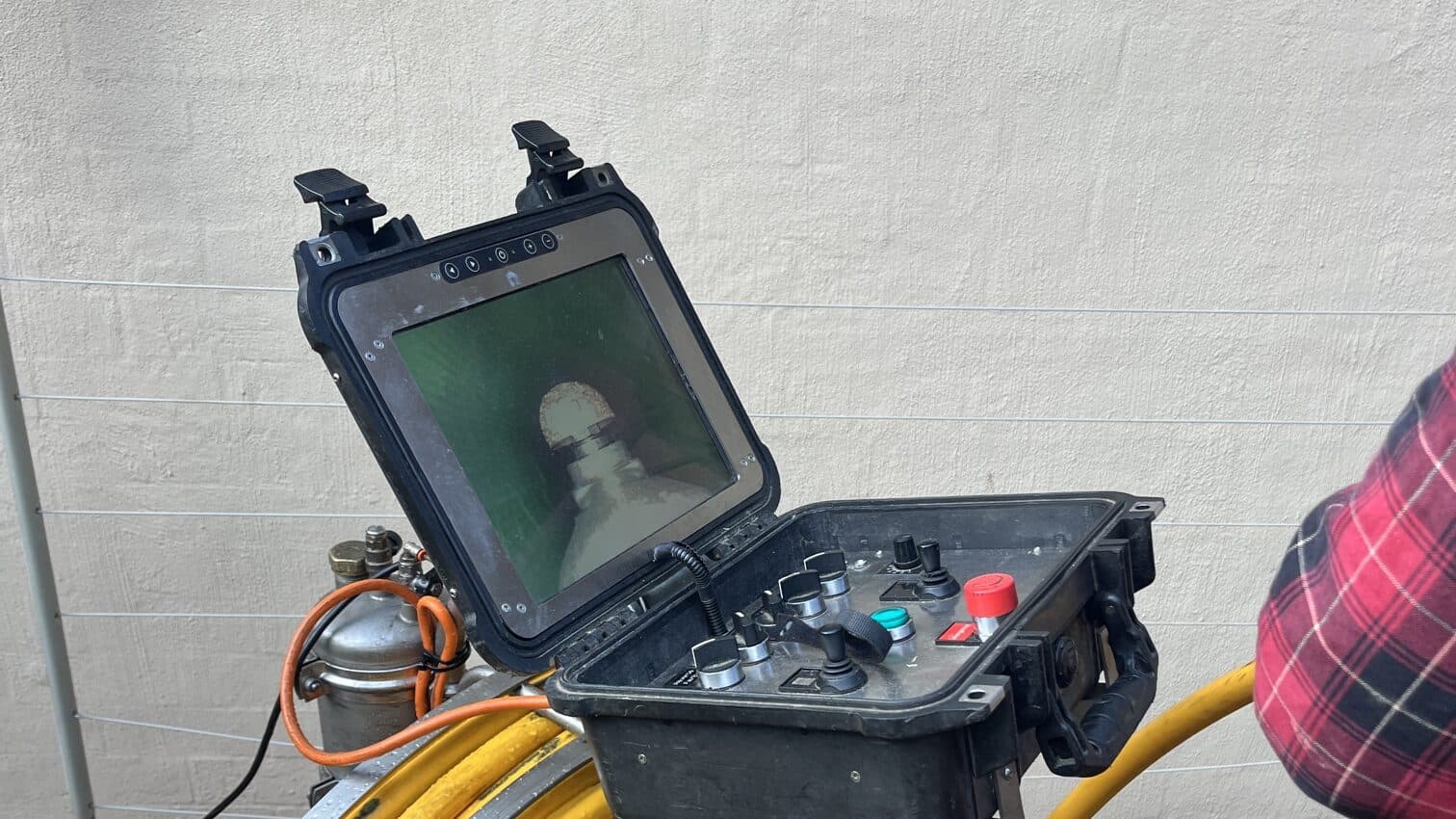
Three technologies, chosen for the situation rather than used in sequence. Acoustic correlation picks up the sound a pressurised leak makes travelling through pipe and soil, and it’s how most underground supply leaks get pinpointed. Thermal imaging finds hot water leaks under slabs and behind tiles by the temperature difference they create. Tracer gas — a hydrogen-nitrogen mix introduced into an isolated line — finds the leaks the other two can’t, because the gas escapes at the leak point and nowhere else.
Before any of that, we isolate. Shutting off sections of the property one at a time tells us which line is losing water, and sometimes ends the job there — a leaking irrigation solenoid or a running toilet doesn’t need a thermal camera to prove it.
You get the location marked on the surface, with a depth where we can give one, and a written report with images. That report is what your insurer will ask for, so it’s produced as a matter of course rather than on request.
The alternative to locating a leak is looking for it, and looking for it means opening things up. Four exploratory holes in a ceiling, a section of tiled wall removed, a strip of driveway broken out — and then the repair itself, plus reinstating everything that was opened for nothing.
The cost of proper detection is almost always less than the reinstatement it avoids, and on a tiled bathroom or a stamped concrete driveway it isn’t close. This is the whole reason the equipment exists.
A lot of housing across the Hills District and the newer estates is on a concrete slab with supply lines cast into or running beneath it. When one of those fails, the water has nowhere to go but into the ground under your house.
That produces the damage nobody budgets for: saturated fill, movement, cracked tiles and doors that stop closing. A slab leak found early is a repair to a pipe. A slab leak found late is a repair to a pipe plus a conversation about the floor above it.
Repair doesn’t always mean breaking the floor, either. Depending on where the failure is, re-routing the affected line overhead or through a wall is often faster, cheaper and less disruptive than opening the slab — we’ll tell you which applies once we know where it is.
Underground supply runs on acreage in Dural, Kenthurst, Galston and Annangrove, where a hundred metres of buried line between the meter and the house means a leak can surface a long way from its source — or not surface at all.
Slab leaks in the newer estates from Kellyville through to The Ponds. Wall-cavity leaks in the older Hornsby and Upper North Shore housing, usually at a failed compression joint that has been quietly weeping for years. And irrigation and pool lines everywhere, which are the single most commonly forgotten source of a big water bill.
How it works
We confirm you’re actually losing water and narrow it to a section of the property.
Acoustic, thermal or tracer gas — whichever suits the pipe, the depth and the surface.
You see exactly where it is and how deep before anyone opens anything.
Including the option to re-route rather than excavate where that’s the better answer.
Customer reviews
“I would like to thank Rohan & the team for coming to my home in Castle Hill. They did a fantastic job replacing my old hot water system, and they gave me a great deal on other plumbing options. The best thing was, they were neat and tidy compared to most other tradies I would highly recommend Precision Pipes”
“We recently used Ben from Precision Pipes and couldn’t be happier with the service. Ben was punctual, transparent, and kept us informed every step of the way. He went above and beyond to explain what was happening and made the whole process stress-free. If you’re looking for an honest, reliable plumber in the Hills District, I wouldn’t hesitate to recommend Ben and the team at Precision Pipes.”
“I’ve been using Precision Plumbing for the past year for both reactive and preventative plumbing maintenance. Rohan and his team have consistently been reliable, punctual, and professional, delivering high-quality workmanship on every job. I highly recommend Precision Plumbing to anyone looking for a trustworthy and dependable plumbing service.”
Where we work
Based in Castle Hill and covering the whole of the north-west and upper north shore.
Common questions
It depends on how much of the property has to be eliminated before the leak is found, and which equipment the situation calls for — a single suspect bathroom is a short job, while a hundred-metre acreage supply run with no obvious surface sign takes longer and usually needs tracer gas. There’s no call-out fee and no charge to quote, and you get a fixed price before we start. It’s worth weighing against the alternative: exploratory demolition costs more than detection almost every time, and it might still miss.
Do the meter test. Turn off every tap, appliance and the irrigation, then note the meter reading and check it again ten minutes later. If it has moved, water is escaping somewhere on your side of the meter. A leaking toilet cistern alone can waste over 200 litres a day silently, so start by putting a few drops of food colouring in the cistern and seeing whether it reaches the bowl without a flush.
Yes — that’s the point of the equipment. We locate it acoustically or thermally, mark it, and only then open a single targeted spot to repair it. In some cases we can avoid opening the slab entirely by re-routing the affected section, which we’ll tell you about before you commit to anything.
Policies vary, but most home policies in NSW cover the resulting damage rather than the failed pipe itself, and many will contribute to the cost of locating it. What insurers consistently ask for is evidence: a written report with photographs, the cause of loss and a scope of works. We produce that on every detection job because it’s what makes the claim straightforward.
On a pressurised supply line in reasonable conditions, usually within a few hundred millimetres — close enough to open one spot. Accuracy drops on very deep lines, under thick reinforced concrete, or where the ground is already saturated, and we’ll tell you honestly when a location is approximate rather than pinpoint rather than letting you find out with a jackhammer.
Yes, but that’s a different process and it’s on our gas fitting page — gas leaks are found by pressure testing the installation and then electronic detection. If you can smell gas right now, leave the building and call from outside.
Advice
Two hot water jobs in the same street can be priced very differently. Here’s what actually moves the number, and how to work out which kind of job you have.
· 7 min read
A TMV holds water at a tighter, safer temperature than a tempering valve and shuts off if the cold fails. Here’s where they’re required and when a home should have one.
· 7 min read
What backflow is, how Sydney Water rates a property, which device goes with which hazard rating, and what the yearly test involves for the owner.
· 6 min read
No call-out fee, a fixed price before we start, and a lifetime labour warranty on everything we do.